
Branded Residences in Dubai: What the 25–35% Premium Actually Buys
Updated: 7 min read
Dubai hosts more branded residences than any city on earth — over 100 completed and pipeline schemes, a lead it has held for years. The category keeps expanding from hotel flags into automotive, fashion and culinary territory, and for investors that means branded product is no longer a niche: it's a distinct asset class with its own pricing logic, buyer pool and resale behavior. This guide breaks down the premium you pay, the three ways you earn it back, two landmark Downtown cases, and the service-charge math that decides whether the numbers work for you.
- 100+
- branded schemes completed or in pipeline
- 25–35%
- price premium vs comparable non-branded
- 15–25%
- rental premium on the flag
- AED 25–40
- service charge per sqft / year
world's largest market
same district
tenants & short-stay
vs AED 12–25 citywide
Dubai Is the Branded Residence Capital of the World
With more branded residences than any city on the planet — over 100 completed and pipeline schemes — Dubai has held this lead for years, and the category keeps widening from hotel flags into automotive, fashion and culinary territory. For investors, branded product is a distinct asset class: it prices differently, sells to a different buyer, and behaves differently at resale than the tower next door.
The definition matters, because not everything marketed as 'branded' qualifies. A true branded residence carries the brand's design standards, brand-supervised management, and contractual use of the name — not a one-off marketing partnership. That contract is precisely what the premium pays for, and it's the line between an asset that holds its premium at resale and one that doesn't.
The 25–35% Premium — and Why It Holds
Branded units in Dubai price 25–35% above comparable non-branded stock in the same district. The premium persists at resale for structural reasons: a global buyer pool that searches by brand before location, professional management that protects asset condition, and rental premiums of 15–25% from tenants and short-term guests who pay for the flag.
relative index
The economics in one line: you pay the premium once at entry, then earn on it three ways — liquidity (faster resale to a wider audience), rate (higher rent per year or per night), and preservation (the brand polices the building's condition so your asset doesn't age like the tower next door). Completed schemes back this up: branded resales in Dubai consistently clear faster and closer to asking price than non-branded peers in the same district.
What the premium actually buys
Three things, not vanity: (1) liquidity — a global audience searches by brand and resale clears faster; (2) rate — 15–25% higher rent from tenants and nightly guests who pay for the flag; (3) preservation — brand-supervised management keeps the building's condition, and therefore your value, from ageing like uncontrolled stock nearby.
Standard vs Branded: The Trade-Off in One Table
Side by side, the choice isn't 'better' or 'worse' — it's a different return profile. Branded trades a higher entry price and heavier service charges for liquidity, rate and preservation; standard stock trades brand cachet for a lower cost base and often a higher cash yield. Here's how the two compare on the metrics that move the decision:
Entry pricing reflects the tier: branded Downtown product typically starts above AED 1.8–2 million, against AED 1–1.2 million for quality non-branded launches in the same skyline. The gap is the price of admission to the brand's buyer pool — and the reason underwriting has to be done on net returns, not headline yield.
Case One: Mercedes-Benz Places by Binghatti
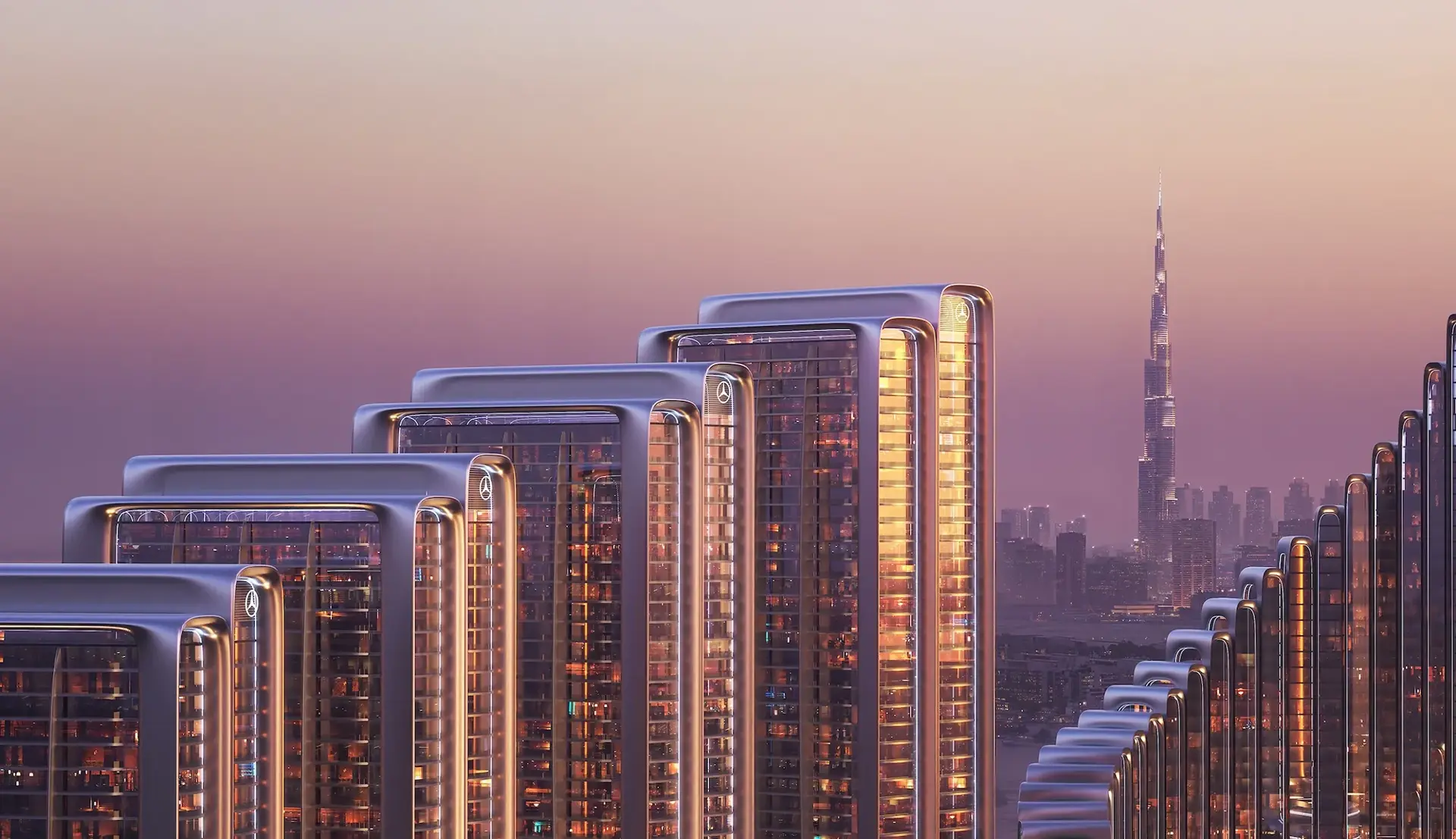
Mercedes-Benz Places in Downtown Dubai is the brand's first residential project anywhere in the world — automotive design language translated into a landmark tower by Binghatti. The investor signal is category scarcity: first-ever brand entries historically command the strongest premiums because no comparable resale stock exists, in Dubai or any other city.
Owners are buying Mercedes-Benz design and service standards inside Dubai's deepest luxury resale market — a combination of brand-new category and proven district that rarely appears twice. When a global-first brand entry lands in the city's most liquid luxury postcode, the scarcity premium and the depth of the exit market reinforce each other.
Case Two: Mr. C Residences
Mr. C Residences in Downtown carries the Cipriani family's hospitality lineage — four generations since Harry's Bar opened in Venice in 1931. Where automotive brands sell engineering and design, culinary-hospitality brands sell daily service: in-residence dining by the brand, concierge culture, and the food-and-beverage gravity that keeps an address socially relevant year after year.
Boutique scale is the other half of the case: limited unit counts versus mega-tower supply support both rental rates and long-term resale scarcity. Fewer keys means the resale market is never flooded by your own neighbours, which protects pricing power on the way out.
The Costs Behind the Glamour
Branded residences carry the market's highest service charges — commonly AED 25–40 per square foot per year against the citywide AED 12–25 — funding brand-standard staffing, amenities and maintenance. Underwrite net, not gross: a 5.5% gross yield on a branded Downtown unit can net 4–4.5% after charges, with the return case completed by appreciation and resale liquidity rather than cash flow alone. Add the 5% VAT on service-charge invoices when modeling net returns.
Gross yield is the wrong number here
On a branded Downtown unit, headline 5.5% gross can land at 4–4.5% net once AED 25–40/sqft service charges and 5% VAT come off. The investment case rests on appreciation and resale liquidity, not rent alone — if you're underwriting on gross yield, you're mispricing the asset.
Entry pricing reflects the tier: branded Downtown product typically starts above AED 1.8–2 million, against AED 1–1.2 million for quality non-branded launches in the same skyline. The premium and the running cost both scale with the brand — so the model only works if appreciation and liquidity carry the return.
Who Should Buy Branded — and Who Should Not
Branded fits capital-preservation mandates, lock-and-leave international owners, and short-term rental operators who can monetize the flag nightly. It fits poorly for pure cash-yield strategies — Dubailand communities at 7–9% gross will always out-yield it on rent alone.
A balanced portfolio pairs one branded Downtown asset for liquidity and appreciation with higher-yield non-branded stock elsewhere. Design-led but unbranded launches — Passo Residences on Palm Jumeirah is a good example — occupy the middle ground: premium product and location without the brand fee built into the price.
Want to see live branded and design-led launches with verified prices, service charges and net-yield math?
Browse off-plan projectsFrequently asked questions
For capital preservation and resale liquidity, yes — branded stock holds value and sells faster to a global buyer pool. For maximum cash yield, non-branded communities in Dubailand outperform at 7–9% gross.